Your Device Connects Over IPv4
Your IP Address is: 216.73.216.223
Unfortunately this means that Hex, the IPv6 cat will stay hidden. You will only see Hex when you connect over IPv6. IPv4 addresses are no longer easily available from the RIRs. IPv6 is the much larger numbering system the Internet needs in order to scale.
Act Now on IPv6
The world’s five Regional Internet Registries - AFRINIC, APNIC, ARIN, LACNIC, and the RIPE NCC, all provide IPv6 learning opportunities and technical resources to help organisations plan, deploy, and operate networks using IPv6.
AFRINIC
The AFRINIC Learning Hub offers multiple courses on IPv6 including creating addressing plans, configuration and transition mechanisms in English and in French.
AFRINIC Learning Hub
APNIC
The APNIC Academy provides multiple online training courses on IPv6 including planning considerations, subnetting concepts and implementation scenarios for ISPs, data centres and enterprises.
APNIC Academy
ARIN
ARIN offers information on IPv6, how to request IPv6 resources, case studies and more on its IPv6 information page.
ARIN IPv6 Information
LACNIC
LACNIC offers IPv6 material in English and Spanish.
Campus LACNIC
RIPE NCC
The RIPE NCC Academy offers free online training in IPv6 Fundamentals, Advanced IPv6 and IPv6 Security, and associated exams with certifications.
RIPE NCC Academy
Why IPv6 Matters
IPv4 has served the Internet well, but it was designed for a much smaller networked world. Workarounds can extend IPv4, but they also add complexity, operational overhead, and limits on innovation. IPv6 gives organisations a better long-term platform for network growth because it helps them:
Scale without constantly working around address scarcity
IPv6 was built to support massive growth in users, endpoints, services, and connected systems.
Simplify network design
With more address space available, networks can be planned more logically and managed more cleanly over time.
Support modern services more effectively
Cloud environments, mobile networks, large enterprise deployments, broadband access, and IoT all benefit from the larger and more flexible addressing model of IPv6.
Reduce dependency on technical workarounds
Heavy dependence on address sharing and translation can create complexity. IPv6 enables more straightforward end-to-end connectivity where appropriate.
Invest in long-term resilience
Deploying IPv6 helps ensure that infrastructure decisions made today will still support digital growth tomorrow.
Common Myths With Deploying IPv6
Recognise any of these myths? IPv6 is not only a technical upgrade. It is a business continuity and growth decision that can enable you to simplify your network architecture, do away with workarounds, and preempt issues with scaling your network for future needs.
“We can wait.”
Waiting usually makes the transition harder. IPv6 is easier to introduce when it is included in normal planning, procurement, and refresh cycles.
“IPv4 workarounds are enough.”
They may keep things running, but they do not solve the long-term scaling problem.
“IPv6 is only for specialists.”
Deployment does require technical planning, but the strategic case is simple: sustainable Internet growth needs IPv6.
IPv6: Where Are We Now?
Measurement and analysis of network activity is essential to guide the development of the Internet. APNIC provides an interactive overview of global IPv6 capability. They publish aggregate information that shows the uptake of IPv6 on a global basis, on a country-by-country basis, and provider-by-provider over time across as much of the Internet as they can encompass with these measurement tests.
Some countries like India, Brazil, Saudi Arabia and the USA are already at a high percentage of IPv6 capability.
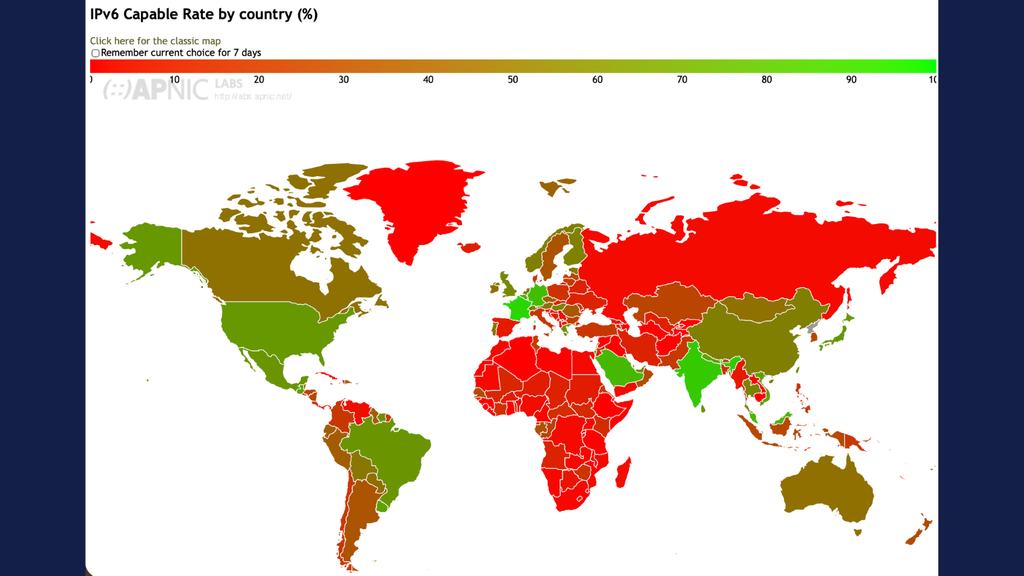 World map showing IPv6 uptake